
The 2026/27 European football season has just kicked off, and every season start brings the same surge of people searching for a VPN to watch it. Here is the answer from people who build a VPN for a living: where a VPN genuinely helps with football, where it doesn't, and what no provider should be promising you.
The case where a VPN works best: you're abroad, locked out of the service you already pay for
This is the cleanest case both technically and in terms of your rights as a subscriber. You pay for a streaming service at home — most sports and TV streaming services restrict viewing to their licensed country — then you travel for work or holiday, open the app, and hit some variant of "not available in your region."
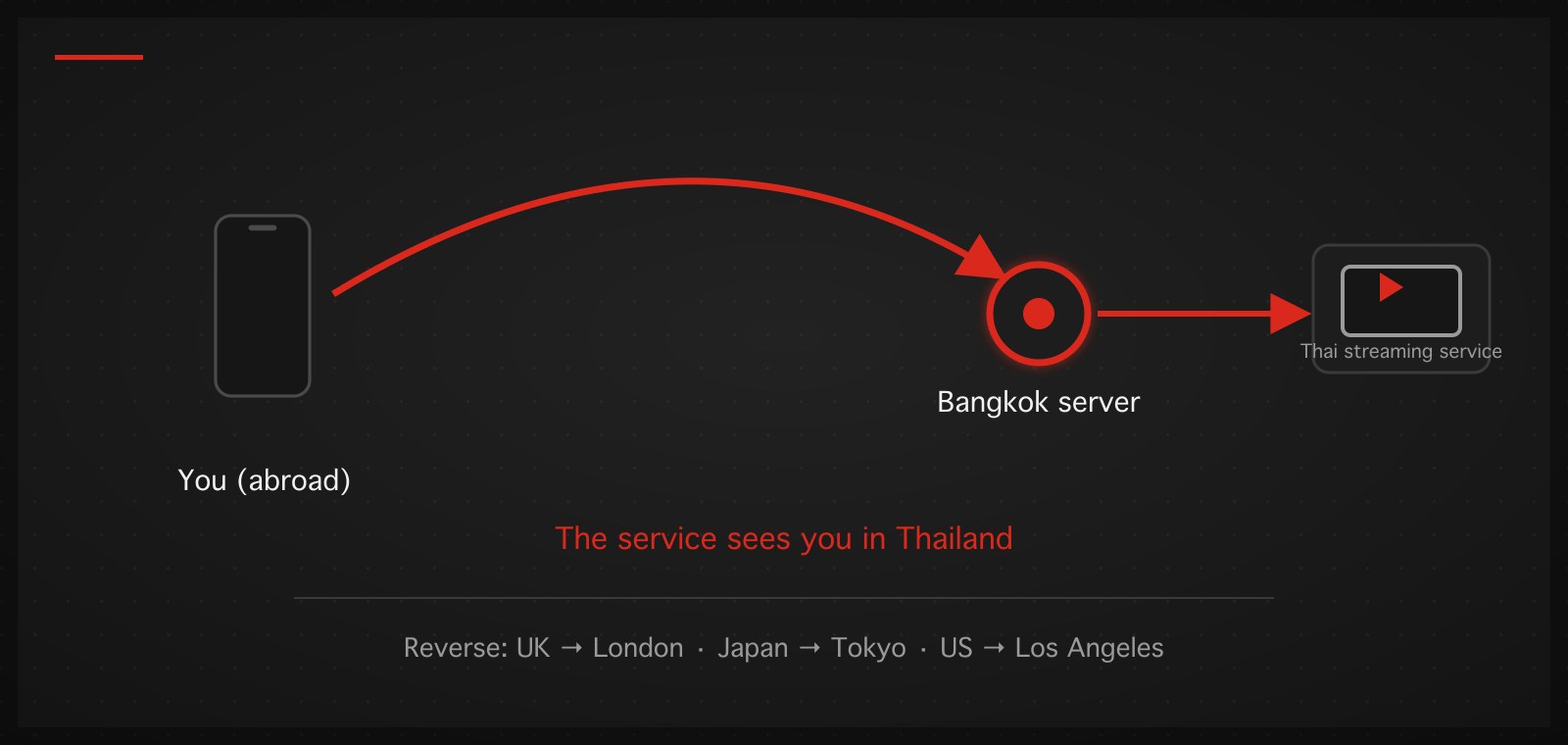
A VPN fixes this by routing your traffic back out through a server in your home country, so the service sees you as watching from where your subscription lives. With TukTukVPN that means picking the Bangkok server for Thai services, or London, Tokyo, Los Angeles, or Singapore for services from those countries — then opening the app as usual.
The honesty that belongs here: every streaming service has its own terms of use, and some address VPN use directly — read the terms of the service you subscribe to. We provide the pipe; the rules at the far end are between you and that provider.
The second case: reaching a service in another country
The reverse direction — watching another country's broadcast that you legitimately have access to, such as an account with that country's streaming service, or a league's official channel that streams to certain countries. Technique is identical: connect to a server in the target country, open the service.
Two things must be said plainly about this case. One: major streaming services detect and block VPN IP addresses as routine business. What works today may be blocked tomorrow, and no VPN on earth can guarantee 100% access to a specific service at all times — a provider that guarantees it is a provider that over-advertises. Two: the terms of the destination service still apply.
Clearing something up: a VPN does not make pirate streams legal
The question that always travels with this search: "is it okay to watch free pirate streams through a VPN?" Straight answer: a copyright-infringing site is a copyright-infringing site whether or not a VPN is involved. A VPN encrypts your connection; it does not change the legal status of what you do over it. Beyond the legal point, pirate streaming sites are prime malware and scam-ad territory. The sustainable path is a licensed service, with the VPN solving the geo-blocking of a service you already have the right to use — the two cases above.
Picking a server for smooth streaming
Simple rules that always hold:
- Watching your home country's service from abroad → the server must be in that country (for Thai services, Bangkok — there is no alternative).
- Reaching a specific country's service → that country's server: UK services → London, Japan → Tokyo, US → Los Angeles.
- Just avoiding streaming throttling (some networks, especially public or dorm Wi-Fi, limit video speeds) → pick the nearest server, so the detour costs as little as possible.
And to say it completely: a VPN always adds distance to your traffic, so it can also make things slower. If your normal connection streams fine and nothing is geo-blocked, there is no reason to have the VPN on while you watch — we sell something that solves real problems, not something you must keep on for life.
Does the protocol matter for streaming?
It does, and it is a case we designed for directly. Live sport needs sustained throughput over imperfect connections — exactly the problem Hysteria2 addresses, a QUIC-based protocol that holds speed well under packet loss and long routes (say, watching a Thai service from Europe). On clean networks, WireGuard is light and more than fast enough.
The good news: you don't need to know any of this. The TukTukVPN app picks the protocol and server automatically for the network you are on at that moment. For the background on how the protocols differ, the plain-language protocol guide covers it.
Before you spend money
- The surest case: watching the home service you already pay for while abroad (home-country server).
- Reaching foreign services: doable, never guaranteed — beware anyone who guarantees it.
- A VPN does not launder pirate streams, and pirate sites are your malware risk to carry.
- Smooth streaming comes down to server distance and protocol — an app that picks both automatically removes that variable.
TukTukVPN runs servers in Bangkok for watching Thai services from abroad, and London, Tokyo, Los Angeles, and Singapore for the other direction. Your first purchase carries a 30-day money-back guarantee — in time for this week's fixtures.